
How Long Does a Water Heater Last? A Northwest Georgia Plumber Answers.
Less on well water. Less without maintenance. Here's what actually cuts that number short in Northwest Georgia.
It's one of the most common questions we hear: "My water heater is X years old — should I be worried?" The honest answer depends on more than just the number. Type of unit, water quality, installation quality, and maintenance history all play a role. In Northwest Georgia, where hard water is a real issue in many parts of Bartow and Cherokee counties, those variables matter more than most national averages suggest.
Here's a straight answer from a plumber who sees these units fail — and what you can do to squeeze every year out of the one you have.
01 — Lifespan by Type
Water Heater Lifespan by Type
Not all water heaters are built the same, and lifespan varies significantly by type. Here's the realistic breakdown based on what we see in the field across Bartow, Cherokee, Cobb, and Paulding counties:
| Type | Average Lifespan | City Water | Well / Hard Water |
|---|---|---|---|
| Gas Tank | 8–12 years | Full range | 6–9 years |
| Electric Tank | 10–13 years | Full range | 7–10 years |
| Gas Tankless | 15–20 years | Full range | 10–15 w/ descaling |
| Electric Tankless | 15–20 years | Full range | 12–16 w/ descaling |
| Heat Pump (Hybrid) | 13–15 years | Full range | 10–13 years |
These are real-world numbers — not manufacturer marketing copy. The upper range assumes annual maintenance, quality installation, and reasonable water conditions. In practice, a tank water heater on hard well water that's never been flushed will often fail closer to 6 or 7 years.
02 — The Hard Water Factor
Why Northwest Georgia Is Hard on Water Heaters
Many parts of Northwest Georgia — particularly homes on private wells in Bartow and Cherokee counties — deal with moderately to severely hard water. High mineral content (calcium and magnesium) settles as sediment inside tank water heaters and as scale inside tankless heat exchangers. The result: reduced efficiency, louder operation, shorter lifespan, and eventually, failure. We see this every week on service calls.
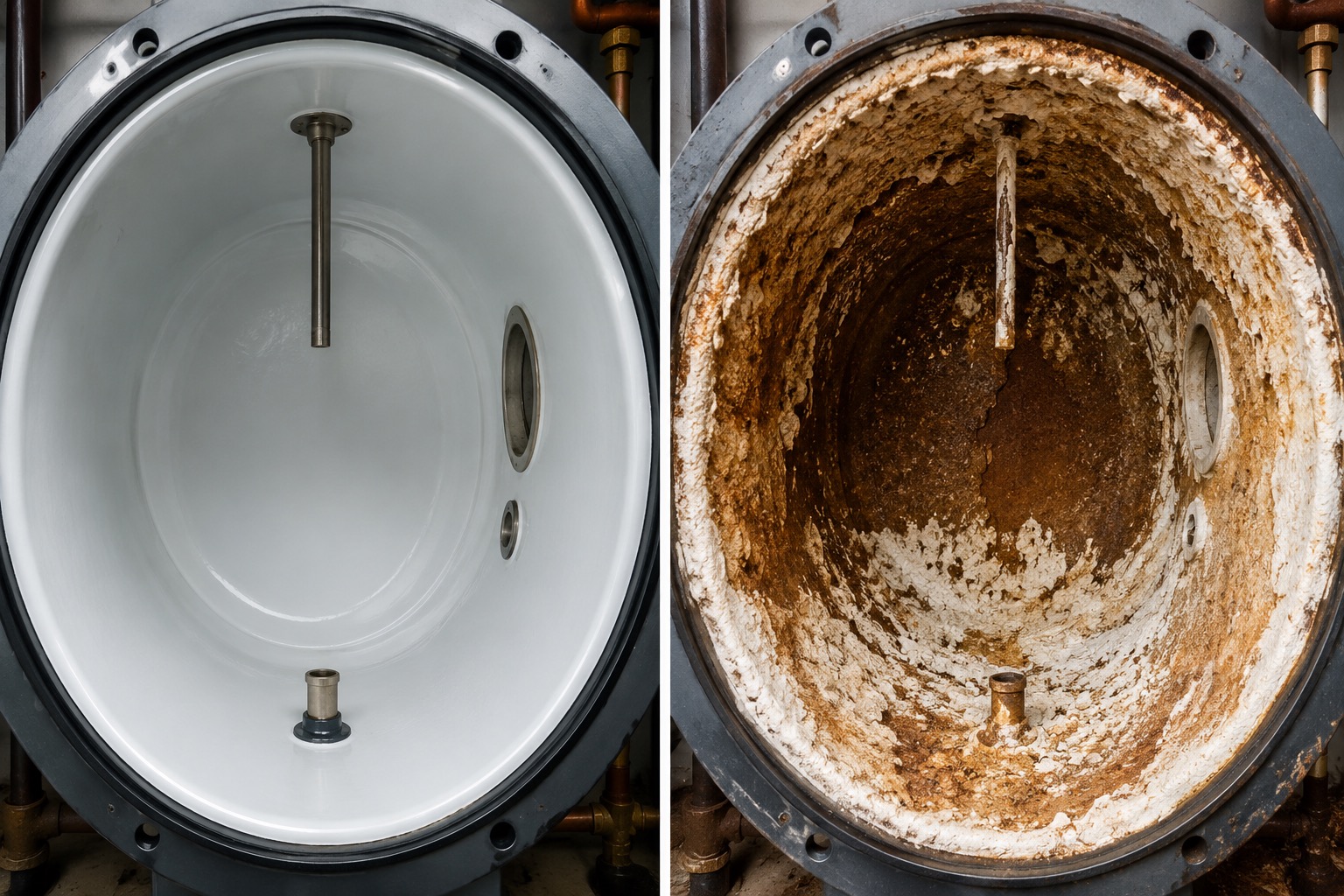
When hard water is heated, the minerals separate and settle. In a tank heater, they pile up at the bottom. You'll often hear a popping or rumbling sound — that's sediment getting knocked around. It insulates the burner from the water, making the unit work harder and run hotter. Over time, it destroys the tank lining from the inside.
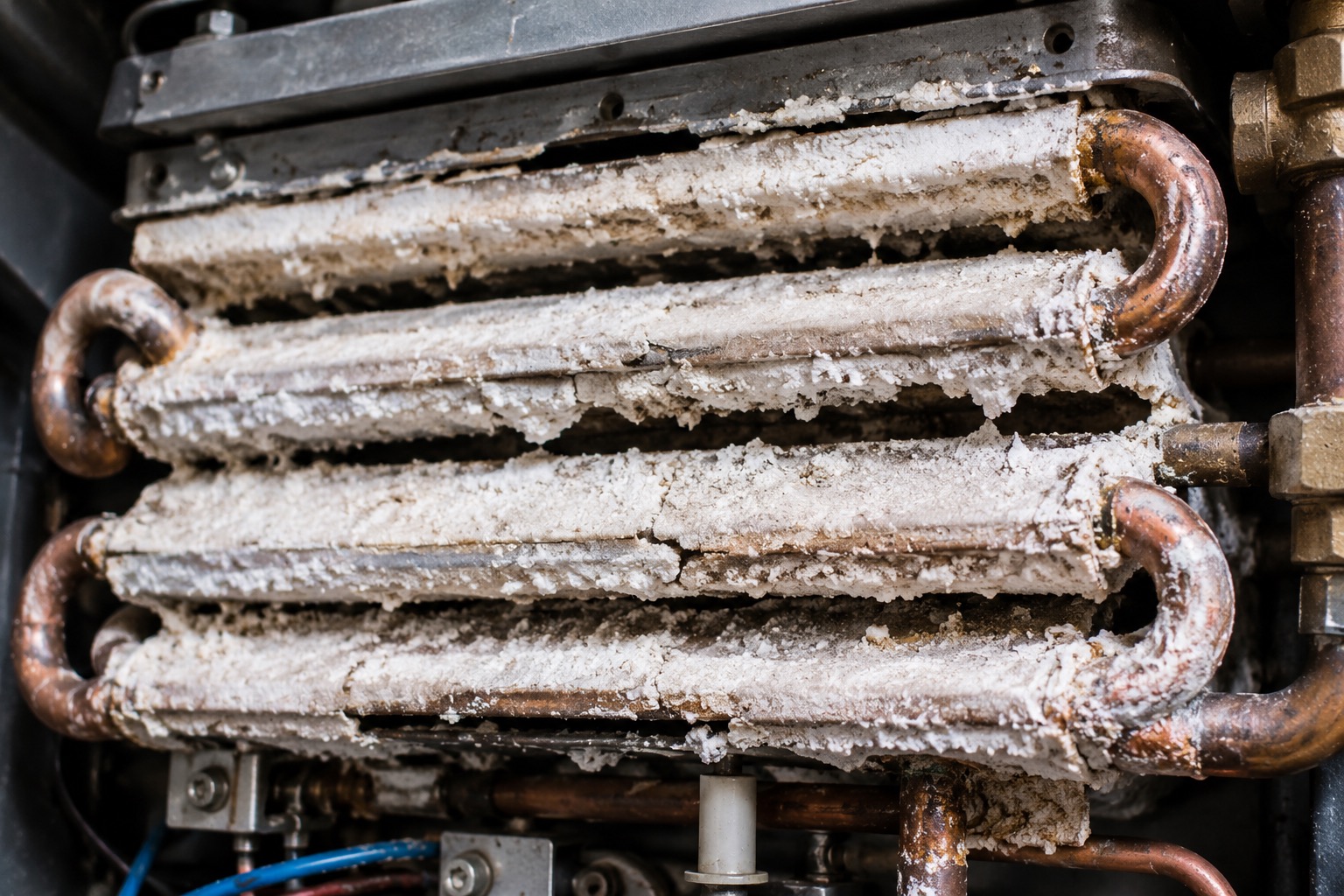
In a tankless unit, scale coats the heat exchanger — the most expensive component in the system. Without annual descaling, a $1,500 heat exchanger can fail in 7–8 years instead of 20.
"Skipping the annual flush on a tank heater is like skipping oil changes on your truck. It works fine — until it doesn't."
— True Grit Plumbing, Emerson GA03 — Warning Signs
7 Signs Your Water Heater Is Nearing the End
Don't wait for a flood or a cold shower. These are the signs we look for when a homeowner calls us saying something isn't right:
Classic sediment buildup. Water heating under a layer of scale creates these sounds. Flushing may help if caught early; if the tank is old, plan for replacement.
Rust coming from the hot tap — not the cold — usually means the tank interior is corroding. This is not repairable. Time to replace.
Small seeps can be fittings or valves — repairable. But moisture from the tank body itself means the tank is cracking. Replace it before it fails completely.
Running out faster than usual, water that won't get hot enough, or temperature swings all point to failing elements, a dying thermostat, or heavy sediment load.
If your tank heater is over 10 years old and hasn't had maintenance, it's living on borrowed time. Plan ahead — don't replace it as an emergency.
A water heater working harder to push heat through sediment uses more energy. If your gas or electric bills are creeping up, the water heater may be the culprit.
One repair is normal. Two or three in a couple of years is a pattern. At that point, continued repairs usually cost more than a replacement over 12 months.
Check the serial number on the label. Most manufacturers encode the year in the first 1–4 characters. We can decode it for you if you call or send us a photo.
04 — How to Find Your Unit's Age
How to Tell How Old Your Water Heater Is
The manufacture date is encoded in the serial number on the label — usually on the side of the tank or inside the access panel on a tankless. Here's how to read it for the most common brands:
- Rheem / Ruud: First character is a letter (month: A=Jan, B=Feb…), next two digits are the year. Example: F22 = June 2022.
- Bradford White: Second character is a letter encoding the year on a cycle (A=1984 or 2004, B=1985 or 2005…). Tricky — call us and we'll decode it.
- A.O. Smith / American Water Heater: First four characters — first two are year, next two are week. Example: 2236 = 36th week of 2022.
- State Water Heaters: Same format as A.O. Smith — first two digits = year, next two = week.
- Navien / Rinnai (Tankless): Usually visible as a full manufacture date on the compliance label inside the front panel.
If you can't figure it out, take a photo of the label and text it to us at 770-847-GRIT. We'll tell you how old it is and whether it's worth repairing.
05 — Maintenance
5 Things That Extend Your Water Heater's Life
Good maintenance can add 3–5 years to the life of a tank heater and keep a tankless running strong for two decades. Here's what actually matters:
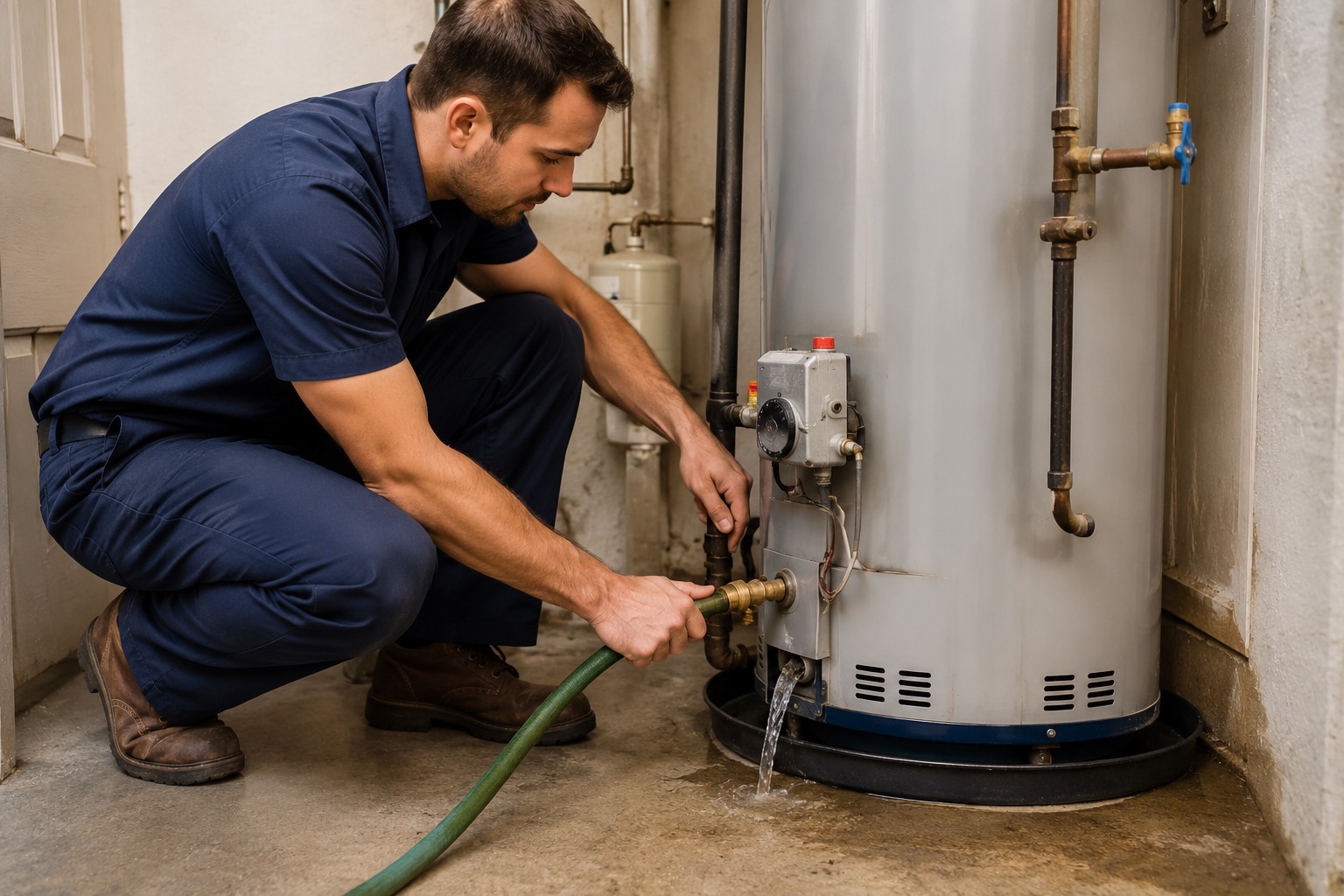
Draining a few gallons from the drain valve removes sediment before it compacts and damages the tank lining. Takes 20 minutes. Skipping it for 3 years costs you 3–4 years of lifespan. We include this with our Grit Guard membership.
The anode rod is a sacrificial magnesium or aluminum rod that attracts corrosive particles and keeps them off the tank walls. When it's fully consumed, corrosion starts on the tank. Replace it before it's gone.
A vinegar or citric acid flush dissolves calcium scale from the heat exchanger. On Bartow County well water, this is especially critical — we've pulled tankless units with heat exchangers completely clogged after 5 years without a flush.
Higher temperatures accelerate sediment buildup and put more stress on the tank and fittings. 120°F is the DOE recommendation — hot enough for comfort and safety, cool enough to reduce strain.
The temperature and pressure relief valve is a critical safety device. It should open and close cleanly. If it's stiff, leaking, or hasn't been tested in years, replace it — it's a $30 part and a 20-minute job. Don't skip it.
06 — Repair vs. Replace
Should You Repair It or Replace It?
The short version: if the unit is under 8 years old and the repair is under half the cost of replacement, repair it. If it's over 10 years old, the math usually favors replacement — even if the current repair is minor.
Repair Makes Sense When:
- Unit is under 8 years old
- Tank itself is not leaking or rusting through
- Repair cost is less than 40–50% of replacement cost
- It's a fixable component — element, thermostat, valve, anode rod
- No sediment damage to the tank lining
Replace When:
- Tank is leaking from the body (not fittings)
- Rust-colored hot water from the tap
- Unit is over 10–12 years old (tank) or 18+ years (tankless)
- Repair cost exceeds 50% of a new unit installed
- You've had 2+ repairs in the past 2 years
We give you a straight answer on this during every service call. We'll tell you what we'd do if it were our own home — not what makes us the most money.
Not Sure If Yours Needs Replacing?
We'll come out, check it over, give you the age, and tell you what we think — no pressure. Most diagnostics take less than 30 minutes.
Book a Water Heater Check Or call: 770-847-GRIT (770-847-4748)07 — FAQ