
How Much Does a Water Heater Replacement Cost in Georgia?
Tank vs. tankless, gas vs. electric, permits, labor, and the questions every Northwest Georgia homeowner should ask before signing anything — answered straight, no fluff.

What Georgia Homeowners Actually Pay in 2026
Water heater prices in Georgia run the full spectrum depending on what you have, what you want, and how complicated the swap turns out to be. For a standard tank-style replacement — same size, same fuel, same location — most Northwest Georgia homeowners pay somewhere between $1,800 and $3,500 installed. Upgrade to tankless and that number climbs to $3,500–$5,800 or more, especially if gas line or venting work is involved.
These aren't lowball estimates padded for surprises or inflated to make your eventual bill look like a deal. They're the real numbers we see on the job every week in Bartow, Cherokee, Cobb, and Paulding counties.
| Water Heater Type | Unit Cost | Installed (Georgia) | Lifespan |
|---|---|---|---|
| Tank — Electric (40–50 gal) | $600–$1,200 | $1,800–$3,000 | 10–15 yrs |
| Tank — Gas (40–50 gal) | $700–$1,400 | $1,800–$3,500 | 10–15 yrs |
| Tankless — Gas | $1,200–$2,500 | $3,500–$5,800+ | 20+ yrs |
| Tankless — Electric | $800–$1,800 | $3,500–$5,000 | 20+ yrs |
| Heat Pump (Hybrid) | $1,400–$2,800 | $2,800–$5,000 | 12–15 yrs |
* Installed prices include unit, standard labor, old unit removal, and basic fittings. Prices may vary based on access, code upgrades, and permit requirements in your county.
What Actually Drives the Price Up (or Down)
There's no single number that fits every job. Here's what moves the needle on your final bill — and which of these you should ask about before your plumber starts the work.
Labor typically accounts for 40–50% of your total. A simple same-for-same swap in an accessible location takes 2–4 hours. Moving the unit, upgrading pipe sizes, or switching fuel types can add half a day or more.
Permits are required in most Georgia counties for any gas appliance replacement or significant plumbing alteration. A licensed plumber should pull the permit and schedule the inspection — if someone offers to skip it to save you money, walk away.
Expansion tanks are now required under code in most closed plumbing systems in Georgia. If your home has a pressure-reducing valve (PRV), your plumber may need to install or replace the expansion tank at the same time. Budget $150–$350 for this add-on.
The cheapest water heater quote isn't always the best deal. What you're really buying is 12 years of reliable hot water — and the workmanship warranty behind it.
Tank vs. Tankless: The Real Tradeoff for Georgia Homes
This is the question we get on almost every water heater call. The honest answer is: it depends on your household, your timeline, and your gas line. Here's how to think through it.
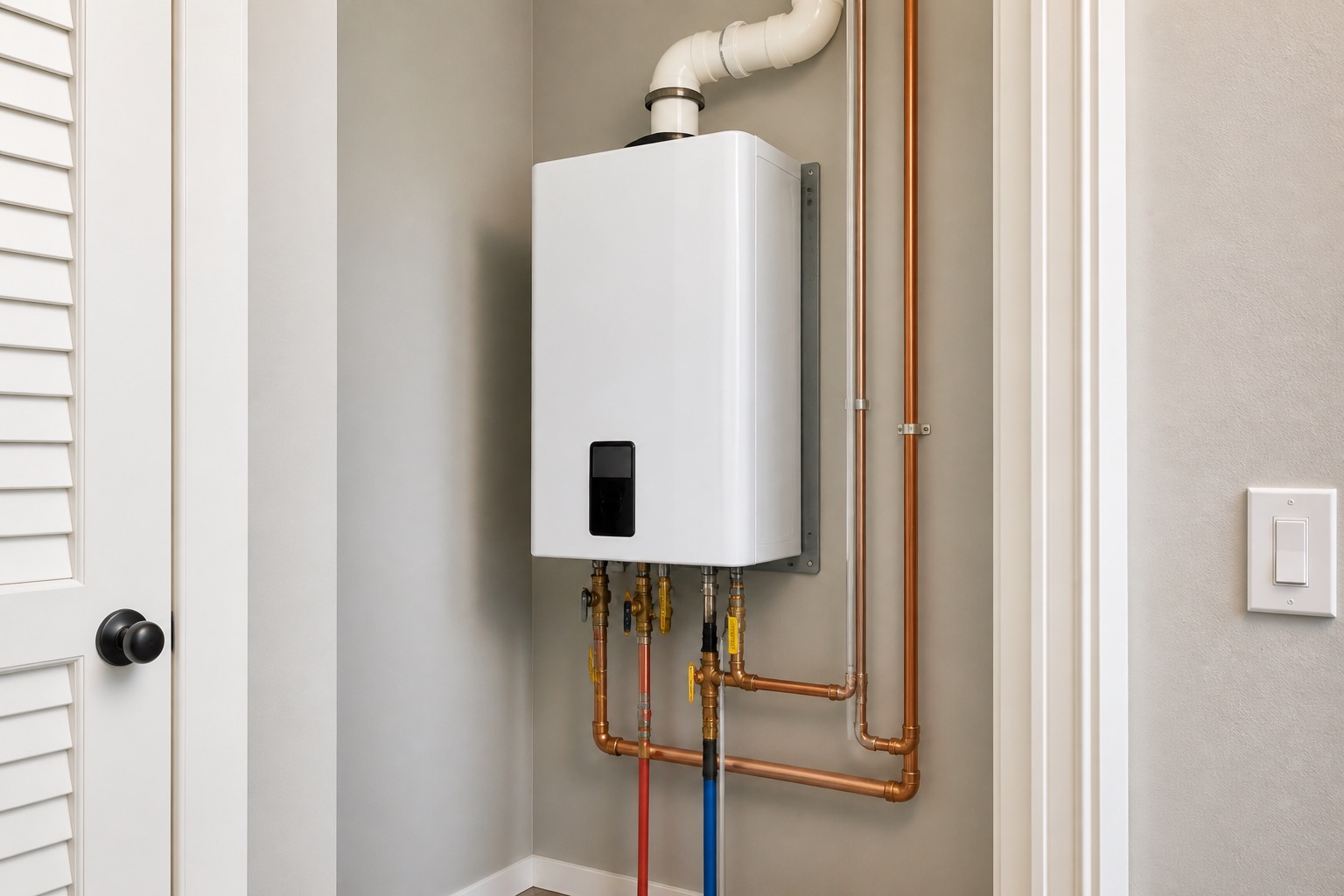
Tankless units mount on the wall and free up floor space — but require larger gas lines and proper venting.
Tank water heaters are lower cost upfront, simpler to install, and easier to repair. For most Georgia families doing a straight replacement with the same fuel type, a quality tank unit from Rheem or Bradford White will serve reliably for 10–15 years with minimal maintenance.
Tankless water heaters heat water on demand — no stored tank means no standby heat loss, which can trim your energy bill meaningfully over time. The catch: they're significantly more expensive upfront, the installation is more complex, and gas-fired tankless units often require upsizing the gas line and adding dedicated venting — both of which add cost.
- Choose tank if you want the lowest upfront cost, straightforward installation, and a simple swap of your existing system
- Choose tank if you're on a budget timeline and plan to sell the home within 5–7 years
- Choose tankless if you run out of hot water regularly with a growing household
- Choose tankless if you're staying in the home long-term and want to reduce energy bills over 15–20 years
- Choose tankless if you're remodeling and want to free up closet or utility room space
One thing that surprises homeowners: switching from a tank to a tankless unit on a gas line that hasn't been upgraded can cause pressure and flow problems. We've seen this on plenty of jobs in Cartersville and Canton — the unit gets installed, but the gas line can't keep up, and the homeowner ends up with lukewarm water and a callback. Always confirm your gas line capacity before committing to tankless.
Gas vs. Electric: What Georgia's Utility Costs Mean for You
In Northwest Georgia, natural gas is widely available and generally cheaper per BTU than electricity for water heating — which is why the majority of homes in Bartow, Cherokee, and Cobb counties run gas water heaters. If your home already has a gas water heater, staying on gas for your replacement is almost always the right call: simpler installation, lower operating cost, and no electrical panel upgrades needed.
Switching from gas to electric — or vice versa — adds significant cost. Running a new gas line or installing a dedicated 240V circuit can add $400–$2,000 to your project. Unless you have a specific reason to switch fuel types, we typically advise against it on a standard replacement.
- Don't switch fuel types just because the new unit is slightly cheaper — the conversion cost will wipe out any savings
- Don't skip the gas line inspection when upgrading to tankless — undersized supply lines cause real problems
- Don't let anyone install a gas appliance without pulling a permit — it's a code violation and a safety risk
- Don't ignore a leaking tank hoping for a repair — a leaking tank cannot be patched and must be replaced
Repair or Replace? How to Know Which One Makes Sense
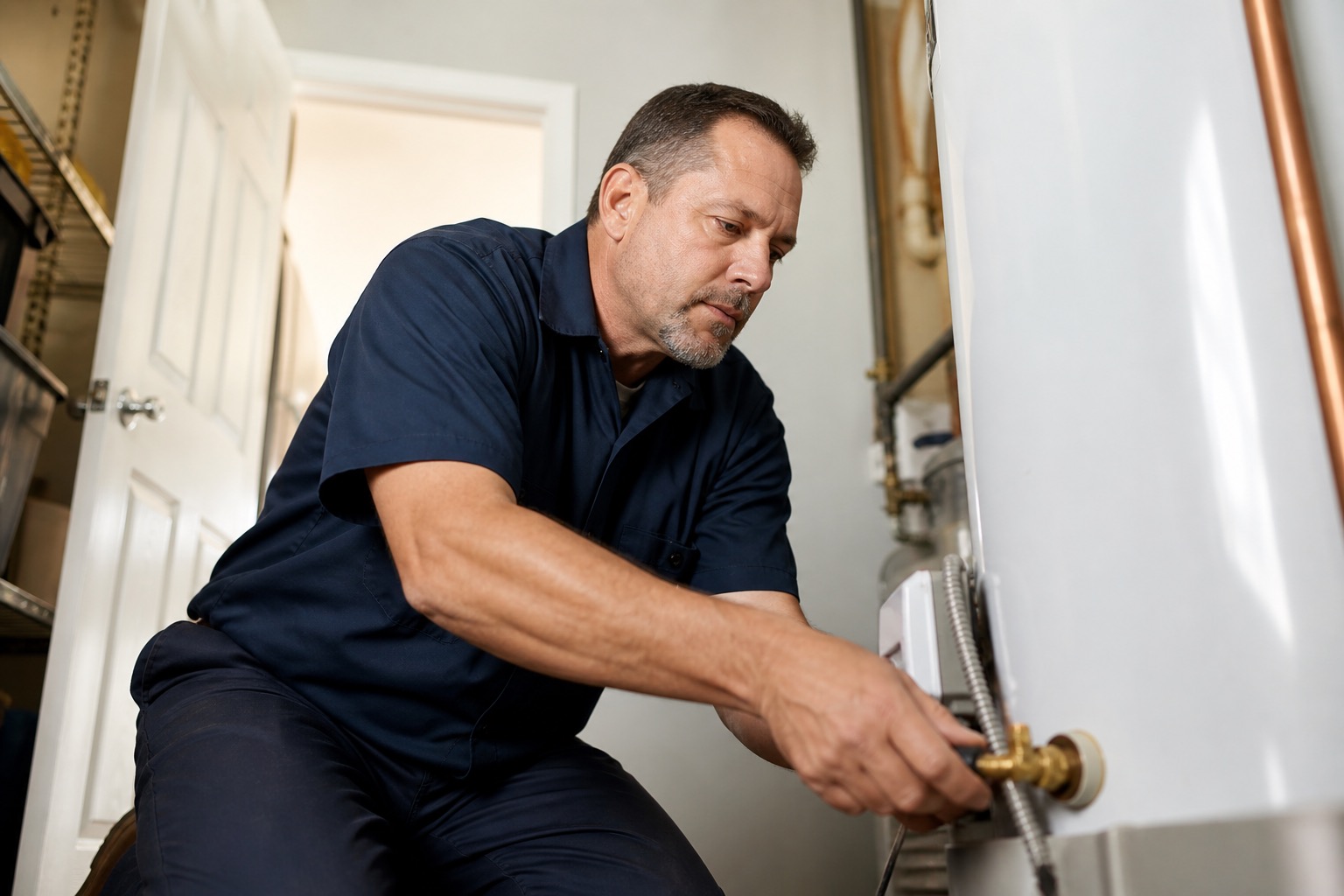
A good plumber will tell you honestly whether repair or replacement is the smarter investment for your specific unit.
The general rule in the industry: if your water heater is under 7 years old and the repair is under $400, fix it. If it's over 10 years old, or the repair costs more than 40–50% of a new unit installed, replace it. A repaired 12-year-old water heater is still a 12-year-old water heater.
There are a handful of situations where replacement is the only answer regardless of age:
- Tank is leaking — a leaking tank cannot be repaired. The metal has corroded through and the unit must be replaced immediately
- Rust-colored hot water — sediment and internal corrosion have compromised the tank lining
- Repeated heating element failures — if you've replaced the element twice in 2 years, the unit is on its way out
- No hot water at all on a unit over 10 years old — at this age, the cost-benefit of repair rarely makes sense
The most common repairable issues we see are thermocouple failures on gas units ($150–$300), heating element replacements on electric units ($200–$400), and pressure relief valve replacements ($150–$300). These repairs make sense on units under 8 years old in otherwise good condition.
95% of calls we get about leaking water heaters end in replacement. Once the tank is leaking, the conversation is over — it's just a matter of what goes in next.
Signs Your Water Heater Is About to Fail
Most water heaters don't fail without warning — they give you signals for weeks or months before they quit entirely. Catching these early means you can replace on your schedule instead of waking up to a flooded utility room on a Sunday morning.
- Age over 10–12 years — the average tank water heater in Georgia lasts 10–15 years. If yours is past a decade, budget for replacement soon
- Rumbling or popping sounds — sediment buildup on the bottom of the tank, hardened by years of heating cycles. It reduces efficiency and accelerates tank wear
- Inconsistent water temperature — hot for a few minutes, then suddenly cold, or never quite hot enough
- Visible rust or corrosion on the tank body, connections, or around the base
- Water pooling around the base — even a small amount of moisture can indicate a slow tank leak
- Rising energy bills without a change in usage — a degrading water heater works harder and costs more to operate
Questions Georgia Homeowners Ask Us Most
Need a Water Heater Quote in Northwest Georgia?
We serve Bartow, Cherokee, Cobb, Paulding, Floyd, Gordon, and Polk counties. Upfront pricing, licensed and insured, no sales pressure — just straight answers and solid work.